
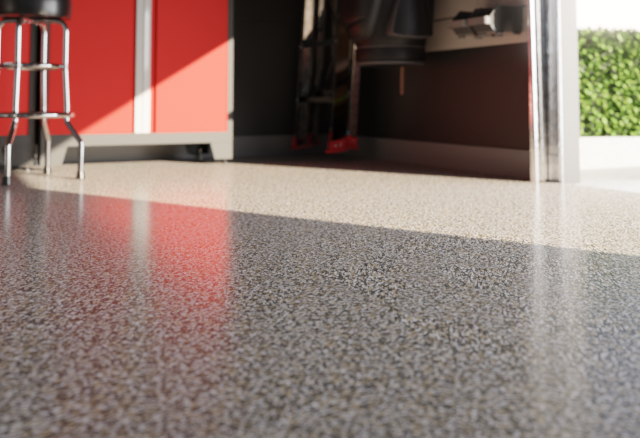
Polyaspartic and epoxy are both resin-based concrete coatings, but they behave very differently once they hit the slab. The short version: polyaspartic vs epoxy comes down to performance in real-world conditions. Polyaspartic cures in hours instead of days, stays clear under UV instead of yellowing, flexes with the concrete instead of cracking, and shrugs off the heat and humidity that wreck most epoxy floors in coastal South Carolina.
Epoxy costs less up front and works fine in dry, climate-controlled spaces, but for garages, basements, and patios in Myrtle Beach and the Grand Strand, a full polyaspartic system is the better long-term choice. Here is the head-to-head breakdown.
Quick Comparison: Polyaspartic vs Epoxy
| Factor | Epoxy | Polyaspartic |
|---|---|---|
| Cure time | 3 to 7 days | Hours (walk on same day, park next day) |
| UV stability | Yellows and chalks under sun | Stays clear, no yellowing |
| Flexibility | Rigid, prone to cracking | Flexible, moves with concrete |
| Hot tire pickup | Common failure point | Highly resistant |
| Humidity tolerance during install | Narrow window | Wide window |
| Application temperature | About 50°F to 90°F | About 0°F to 100°F+ |
| Install time | 3 to 5 days | 1 day |
| Up-front cost | Lower | Higher |
| Long-term value | Often needs recoat or repair | Built to last decades |
What Each Coating Actually Is
Epoxy is a two-part resin system. You mix a resin with a hardener, a chemical reaction kicks off, and the result is a hard, glossy surface bonded to your concrete. Epoxy has been around for decades and is what you find in most DIY kits at the hardware store.
Polyaspartic is a newer technology that came out of the industrial coatings world in the 1990s. It is technically a type of polyurea, formulated with refined resins and curing agents that give it faster cure times, better UV stability, and more flexibility than epoxy. Polyaspartic can be used as a primer, a base coat, a body coat, or a top coat.
The system we install at Garage Kings Myrtle Beach uses a polyaspartic base coat and a polyaspartic top coat with a vinyl flake layer in between for texture and visual appeal.
Cure Time and Install Day
This is the most obvious difference in the polyaspartic vs epoxy debate, and the one most homeowners feel the most.
A traditional epoxy install is a three-to-five-day job. Each coat needs roughly 24 hours to cure before the next one goes on, and you usually wait a full week before parking on it. That means a week of clearing your garage, parking on the street, and rearranging your routine.
A polyaspartic install is a one-day job from start to finish. We grind in the morning, prime, broadcast flake, and top coat through the afternoon. You can typically walk on it that evening and park on it within 24 hours.
If you have a busy household and a single-car driveway in Myrtle Beach, that timeline difference matters.
Durability and Hot Tire Pickup
Both coatings are tougher than bare concrete, but polyaspartic outperforms standard epoxy in most real-world tests. It scores higher on abrasion resistance (Taber tests), holds up better against dragged toolboxes and wire-brush scuffing, and resists chips from dropped tools.
The biggest durability win is what installers call hot tire pickup. After a long drive in summer, your tires are hot and sticky. As they cool on the floor, they can grip and pull up an epoxy coating, leaving lifted patches in front of your parking spots. Polyaspartic is much harder once cured and far less prone to this failure.
For a coastal garage that sees daily use, that alone is a strong reason to choose polyaspartic over epoxy.
UV Stability: A Huge Deal in South Carolina
Standard epoxy is not UV stable. Sunlight breaks down the resin at a chemical level, which causes:
- Yellowing on white, gray, and light-colored floors (often visible within 6 to 18 months)
- Chalking, where the surface becomes powdery
- Loss of gloss, leaving a dull, faded look
In a South Carolina garage with the door open most of the day, or with windows facing south, those problems show up fast. The yellowing usually appears first in the strip near the garage door.
Polyaspartic is fully UV stable. The clear top coat stays clear. Whatever flake color you pick on day one is what you see ten years later, even with the door open in July sun. This is one of the biggest advantages when comparing polyaspartic vs epoxy for coastal environments.
How Each Handles South Carolina Heat and Humidity
The Grand Strand spends most of the year above 70% humidity, with summer surface temperatures inside garages climbing well past 100°F. Both factors hit epoxy hard.
During install: Epoxy needs roughly 50°F to 90°F and humidity below about 75% for proper curing. Outside that window, you get bubbles, soft spots, or coatings that never fully harden. In Myrtle Beach, that window slams shut for big chunks of the year.
After install: Epoxy is rigid. Concrete naturally expands and contracts as it heats and cools, and a brittle epoxy coating cannot move with it. Hairline cracks in the slab telegraph through to the surface, and edges start to lift.
Polyaspartic cures correctly in a much wider temperature and humidity range, and stays flexible enough to move with the concrete. It is also a better partner for moisture vapor coming up through the slab, which is a constant issue in coastal South Carolina. We covered that in detail in our post on how coastal humidity affects your garage floor over time.
Cost Up Front vs. Cost Over 10 Years
Epoxy costs less on day one. There is no getting around that. A DIY kit might run a few hundred dollars, and a budget contractor install often comes in below a polyaspartic quote.
The math changes when you add up the next decade:
- A failed epoxy floor often needs to be ground off and recoated within 3 to 7 years in a coastal climate
- Repairs to lifted, peeling, or yellowed epoxy are visible and rarely match the original color
- A properly installed polyaspartic floor is built to last decades – our system comes with a 10-year or 21-year warranty covering materials and labor
Once you factor in a likely recoat, polyaspartic almost always wins on long-term cost. Understanding the questions to ask before hiring a garage floor coating company helps you evaluate the true value proposition.
For a coastal South Carolina garage, polyaspartic is not just a nicer floor. It is the only coating engineered to handle the heat, humidity, UV, and salt air without failing early.
When Epoxy Still Makes Sense
To be fair, epoxy is not a bad product in every situation. It can be a reasonable choice when:
- The space is fully indoors and climate-controlled (a finished workshop, a clean storage room)
- The slab gets no direct UV exposure
- Up-front cost is the main priority, and you understand the trade-offs
- You are using it as a base coat with a polyaspartic top coat as a hybrid system
For most homeowners on the Grand Strand, those conditions do not apply. The garage door opens. The sun pours in. The summer humidity is real. That is polyaspartic territory.
A Quick Word on DIY Kits
Both materials can be sold as DIY kits, but the products in those boxes are not the same as what a professional crew installs. The DIY versions are thinner, weaker, and skip the most important step: full diamond grinding of the concrete.
Without proper prep, no coating sticks long-term, no matter how good the chemistry. If you are seriously comparing options for a garage floor, basement floor, or patio coating in South Carolina, get a quote on a professional polyaspartic install before you decide. The price gap is usually smaller than people expect, and the lifespan gap is huge.
Proper Maintenance Makes Both Last Longer
Regardless of which coating you choose, proper care extends its lifespan. For polyaspartic floors specifically, our guide on how to maintain a polyaspartic garage floor coating covers everything from daily cleaning to long-term protection strategies.
Regular maintenance includes:
- Sweeping or hosing out dirt and debris
- Using pH-neutral cleaners
- Wiping up spills promptly
- Avoiding harsh chemicals and metal brushes
Get a Polyaspartic Quote for Your South Carolina Garage
Ready to skip the epoxy headaches? Garage Kings Myrtle Beach installs full polyaspartic floor systems built for South Carolina coastal conditions, with a one-day install and your choice of a 10-year or 21-year warranty on materials and labor.
Our certified installers serve homeowners throughout Myrtle Beach, North Myrtle Beach, Conway, Murrells Inlet, Pawleys Island, Carolina Forest, and nearby Grand Strand communities.
Call 843-892-6060 or request a quote online for a free consultation and detailed estimate.