
Living near the ocean in Myrtle Beach means dealing with constant humidity in garage floor spaces that creates serious problems for concrete. Moisture pushes water vapor through your slab, leaving chalky deposits and causing bare floors – and poorly applied coatings homeowners install themselves – to crack, dust, peel, or bubble. The solution isn’t paint or a DIY epoxy kit. It’s proper concrete preparation, moisture testing, and a professional polyaspartic coating system built for coastal conditions.
Below is what’s actually happening beneath your floor, warning signs to watch for, and how to protect your investment with the right garage floor coatings.
What Coastal Humidity Does to Concrete Garage Floors
Concrete is porous. While it looks solid, microscopic capillaries act like tiny straws at the structural level. In Myrtle Beach, where humidity hovers above 70% much of the year and the water table sits high, those capillaries continuously pull moisture from the soil and push it through your slab’s surface. This humidity in garage floor slabs is called moisture vapor transmission (MVT).
When vapor hits a sealed coating that doesn’t allow escape, pressure builds between the concrete and coating. Eventually, that pressure becomes strong enough to lift, bubble, or peel the coating right off the slab – a common problem many Myrtle Beach homeowners face when they skip proper surface preparation.
Coastal properties also face three additional humidity-related problems:
Efflorescence: That white, chalky residue on bare garage floors is salt and mineral deposits left when moisture evaporates through concrete.
Salt air corrosion: Atmospheric salt from the ocean settles on every surface. On bare concrete, it accelerates breakdown and can pit the slab.
Mold and mildew: Trapped humidity in garage floor areas under vehicles, behind storage cabinets, and along garage door thresholds creates perfect breeding grounds, especially during summer months.
5 Warning Signs Humidity Is Damaging Your Myrtle Beach Garage Floor
Walk into your garage and check for these indicators of humidity in garage floor damage:
- Dusting: Fine gray powder on your shoes after sweeping means the slab is breaking down at the surface level – one of the most common signs you need professional intervention.
- White stains or chalky residue: Classic efflorescence from minerals pushing through the concrete due to moisture movement.
- Dark spots that never fully dry: Areas holding moisture longer than surrounding concrete – these are moisture vapor transmission hot spots.
- Bubbles, blisters, or peeling on old coatings: Clear evidence moisture got trapped under a previous epoxy or paint application.
- Hairline cracks spreading from joints: Coastal moisture combined with seasonal temperature changes widens concrete garage floor cracks over time.
If you notice two or more signs, your floor needs a professional garage floor coating solution before the damage worsens.
Why Standard Epoxy Fails in Humid Climates
Most off-the-shelf and many older professional epoxy systems were designed for dry climates. In a Myrtle Beach garage environment with high humidity in garage floor spaces, they encounter several critical problems:
They don’t breathe: Epoxy forms an impermeable seal. Moisture vapor pushing from below gets trapped, causing bond failure.
They cure slowly: During humid stretches from May through September along the Grand Strand, epoxy can stay tacky for days or never fully harden.
They yellow under UV: Sunlight through open garage doors causes most epoxy to fade and chalk within months.
They can’t handle salt residue: Tracked-in beach sand and salt accelerate surface wear, particularly near the door apron where vehicles enter.
The most common cause of garage floor coating failure in coastal South Carolina isn’t bad luck – it’s humidity in garage floor environments trapped under a system never designed to handle coastal conditions. Before hiring any contractor, make sure you’re asking the right questions about their preparation process and coating systems.
How Polyaspartic Coatings Handle Coastal Humidity Differently
A properly installed polyaspartic garage floor coating is engineered specifically for environments like Myrtle Beach where humidity in garage floor spaces causes constant problems. Here’s what sets it apart from traditional epoxy:
Faster cure time: Polyaspartic coatings cure in hours, not days, leaving minimal window for ambient humidity to disrupt the installation chemistry. This is crucial during South Carolina’s humid summer months.
Stronger mechanical bond: When the slab is diamond-ground first, polyaspartic resin penetrates deep into open pores and locks in permanently – creating a mechanical bond rather than just a chemical adhesion.
UV stability: The clear top coat stays clear – no yellowing or chalking, even in direct summer sun streaming through your garage door.
Chemical and salt resistance: The cured surface resists salt, oil, gasoline, pool chemicals, and most household solvents without degrading.
Flexibility: Polyaspartic flexes slightly with concrete movement instead of cracking the way rigid epoxy systems do – essential for handling the expansion and contraction caused by coastal temperature swings.
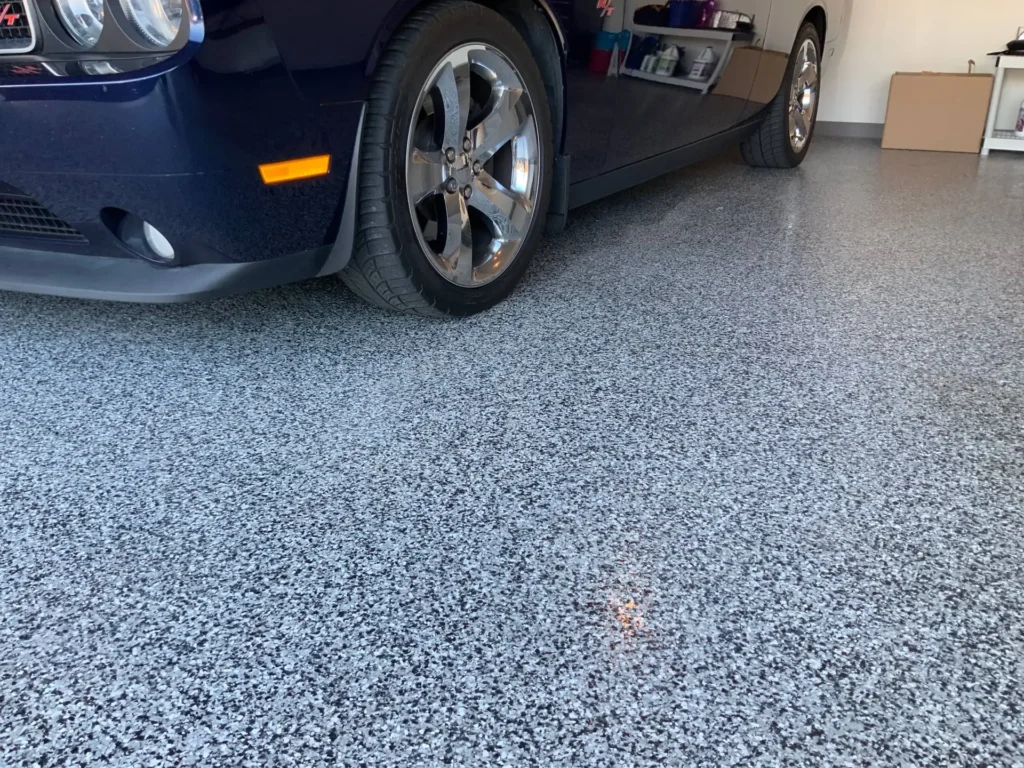
Our system uses a polyaspartic base coat with a polyaspartic top coat and vinyl flake layer between for texture and visual appeal. It’s the same professional-grade system we install on every garage floor coating, basement floor coating, and concrete patio coating throughout the Grand Strand area.
Surface Preparation: The Real Difference Maker for Humid Environments
The coating gets credit, but preparation does the work. In humid coastal climates, skipping or cutting corners on prep is the single biggest reason coatings fail when dealing with humidity in garage floor concrete. Our process includes:
Moisture testing: We check the slab before quoting any aggressive coating so we understand exactly what we’re working with. ASTM standards require testing moisture levels before applying any coating system.
Diamond grinding: Heavy diamond-grinding equipment opens the surface profile so coating bonds mechanically, not just chemically. This removes surface contaminants, laitance, and creates the proper concrete profile for maximum adhesion.
Crack and pit repair: All structural cracks, control joints, spalling, and divots are filled with industrial-grade repair products designed for coastal environments.
Vapor barrier consideration: In extreme cases of humidity in garage floor slabs, we may recommend moisture mitigation products before coating application.
Vacuum and cleaning: Dust collection during grinding plus final vacuum pass before any coating application ensures a contamination-free surface.
Warning: If a contractor wants to coat your floor without diamond grinding first, that’s a major red flag. Acid etching and simple cleaning aren’t sufficient for long-lasting coastal installations dealing with high humidity.
Understanding Moisture Vapor Transmission (MVT) in Coastal Garages
Humidity in garage floor concrete happens because of moisture vapor transmission. Here’s how it works in Myrtle Beach’s coastal environment:
The water table along the Grand Strand sits relatively high compared to inland areas. Groundwater naturally contains dissolved minerals and salts. As moisture moves upward through concrete’s porous structure via capillary action, it carries these minerals with it.
When the moisture reaches the surface and evaporates, it leaves the minerals behind – creating efflorescence. If a coating is present that doesn’t allow the moisture to escape, pressure builds up underneath until the coating fails.
Professional moisture testing measures the rate of moisture vapor emission from your concrete slab. This tells us whether:
- Your slab can accept a standard coating system
- You need moisture mitigation products first
- The slab requires extended drying time before coating
Maintenance Tips for Coastal Garage Floor Coatings
Once your garage floor coating is professionally installed to handle humidity in garage floor environments, upkeep is simple. To maximize the longevity of your investment:
- Hose or sweep out beach sand and salt residue regularly, especially during summer months when beach traffic is highest
- Wipe up oil, gasoline, and pool chemicals promptly, even though the polyaspartic coating resists them
- Use mild pH-neutral cleaner with a soft mop or deck brush for deeper cleaning – avoid harsh chemicals
- Avoid harsh acid-based cleaners and metal-bristle brushes that can dull the finish over time
- Keep weather stripping along the garage door in good condition so wind-driven rain doesn’t pool against the apron
- Run a dehumidifier during extreme humidity periods to keep your garage environment comfortable and reduce moisture stress
For detailed care instructions, see our guide on how to maintain a polyaspartic garage floor coating.
Complete Your Garage Organization System
While you’re upgrading your garage floor to combat humidity in garage floor spaces, consider maximizing your space with professional storage solutions. Many Myrtle Beach homeowners combine their floor coating project with overhead garage storage installation and garage cabinet installation to create a fully functional, humidity-resistant garage system.
Overhead storage keeps seasonal items, holiday decorations, and beach equipment off your beautiful new floor, while custom cabinets protect tools and equipment from coastal humidity and salt air.
Get Your Myrtle Beach Garage Floor Protected Before Peak Humidity Season
Don’t let coastal humidity in garage floor concrete destroy your investment. Understanding why concrete garage floors crack and taking preventive action now will save you thousands in future repairs.
Garage Kings Myrtle Beach installs polyaspartic floor systems engineered specifically for coastal heat, salt, and humidity. Our one-day installation process means minimal disruption to your schedule, and your choice of 10-year or 21-year warranty covering both materials and labor provides peace of mind that your investment is protected.
Our certified installers serve homeowners throughout Myrtle Beach, North Myrtle Beach, Conway, Murrells Inlet, Pawleys Island, Carolina Forest, and nearby Grand Strand communities.
Ready to protect your garage floor from coastal humidity damage?
Call 843-892-6060 or request a free quote online today. We’ll schedule a free consultation, assess your concrete’s condition, perform moisture testing, and provide a detailed estimate with no obligation.l 843-892-6060 or request a quote online for service in Myrtle Beach, North Myrtle Beach, Conway, Murrells Inlet, Pawleys Island, and nearby Grand Strand communities.