
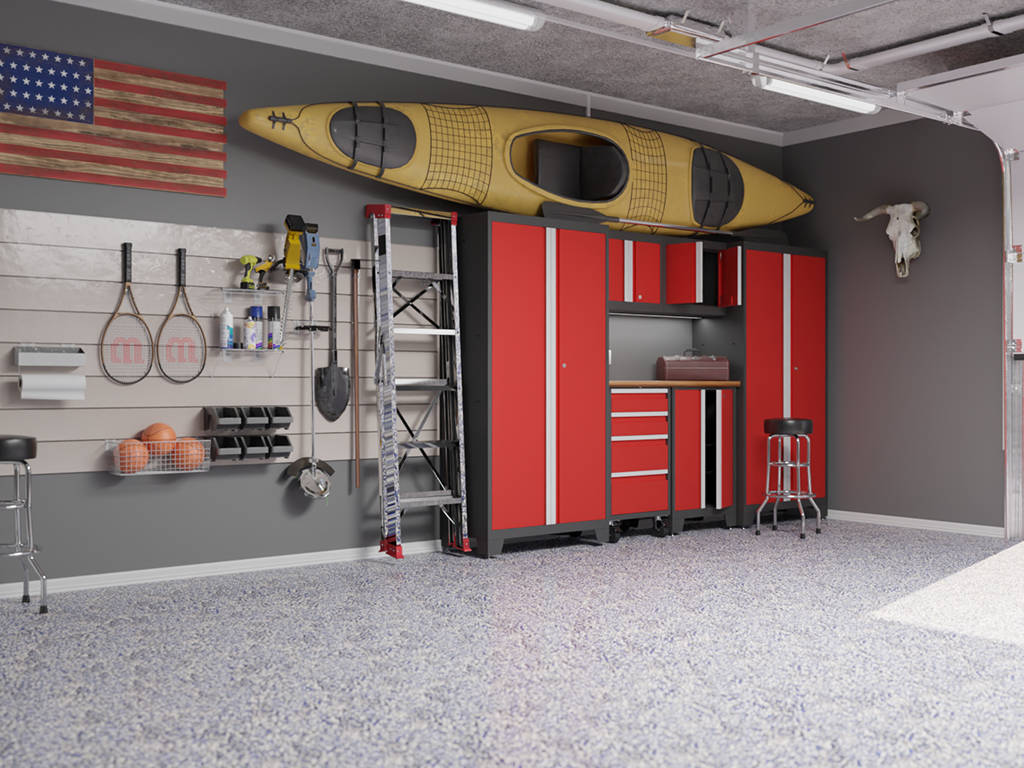
For a garage, slatwall holds up better than pegboard. It carries more weight, resists wear and moisture, and lets you rearrange hooks and shelves without leaving holes behind. Pegboard is less expensive and fine for light hand tools, but hardboard pegboard sags under load, wears out at the holes, and swells in humid air. In a coastal garage on the Grand Strand, that moisture difference alone is a big deal. Here is how the two systems compare on the things that actually matter, where each one makes sense, and why slatwall is the more durable pick for most garages here.
Pegboard: Strengths and Limits
Pegboard is the classic garage wall panel, usually made from hardboard (engineered wood) with a grid of holes, though metal versions exist. It has real advantages:
- Inexpensive and easy to find: it is the budget option and available at any hardware store.
- Great for light hand tools: screwdrivers, pliers, and small accessories hang perfectly.
- The silhouette trick: the fixed grid lets you outline each tool so everything has a visible home, which no other system does as well.
The limits show up when you ask more of it. Standard hardboard pegboard holds only about 5 to 20 pounds per hook, the holes wear out and tear over time, and the panel bows away from the wall where it is loaded heavily. Worst of all for our area, hardboard absorbs moisture and can swell in a humid garage.
Slatwall: Strengths and Limits
Slatwall uses panels with horizontal grooves that hooks, baskets, and shelves lock into. It is made from PVC, MDF, or aluminum, and it is built for heavier, everyday garage use:
- Higher weight capacity: the continuous groove spreads the load, so accessories hold far more than a pegboard hook, which is what lets slatwall carry bikes, power tools, and gear.
- More durable: PVC and aluminum resist chipping and cracking and shrug off dropped tools better than hardboard.
- Moisture resistant: PVC and metal slatwall do not swell the way hardboard does, which matters in a damp or coastal garage.
- Fully adjustable: hooks and shelves slide and reposition anywhere along the grooves without new holes, so the wall changes as your needs do.
The tradeoffs are honest ones: slatwall costs more than pegboard and takes more care to install, since it needs to be anchored into the wall studs to carry its rated weight.
Head-to-Head Comparison
Here is how the two stack up on the factors that decide the choice:
| Factor | Pegboard (hardboard) | Slatwall (PVC/metal) |
|---|---|---|
| Weight per hook/accessory | Low (about 5 to 20 lbs) | High (spreads load along the groove) |
| Durability | Holes wear and tear; panel bows | Resists chips, cracks, and sagging |
| Moisture resistance | Poor; hardboard can swell | Strong; PVC and metal resist moisture |
| Adjustability | Fixed grid of holes | Slides and repositions freely |
| Cost | Lower | Higher |
| Best for | Light hand tools, tight budget | Heavy gear, long-term durability |
Pegboard wins on price and light hand tools. Slatwall wins on weight, durability, and moisture, which is what “holds up” really means in a garage.
The Coastal Factor
On the Grand Strand, the moisture line in that table carries extra weight. Garages here deal with high humidity year-round, and hardboard pegboard is exactly the kind of material that takes on moisture, swells, and starts to sag or warp over time. PVC and metal slatwall are far more at home in that environment, holding their shape and strength through the humidity. If you want a wall system that still looks and works right in a few years, the coastal climate tilts the decision toward slatwall.
Which Should You Choose?
The best answer for a lot of garages is both, used where each one shines. Run slatwall as your main storage wall for the heavy, everyday gear, bikes, and baskets, and add a small section of pegboard above a workbench for light hand tools and the silhouette-outline setup. If you are picking just one for a humid coastal garage that needs to hold real weight, slatwall is the one that holds up. Our slatwall and cabinet systems are built and installed to carry their rated loads, and you can see how a slatwall wall transforms a space in our Conway slatwall storage post. Pair it with overhead racks and almost everything comes off the floor.
Ready to Build a Wall That Holds Up?
If you want garage wall storage that carries real weight and lasts in our coastal humidity, Garage Kings Myrtle Beach can design and install a slatwall system around your gear and your space. Call 843-892-6060 to get your quote, serving Myrtle Beach, SC and nearby areas.