
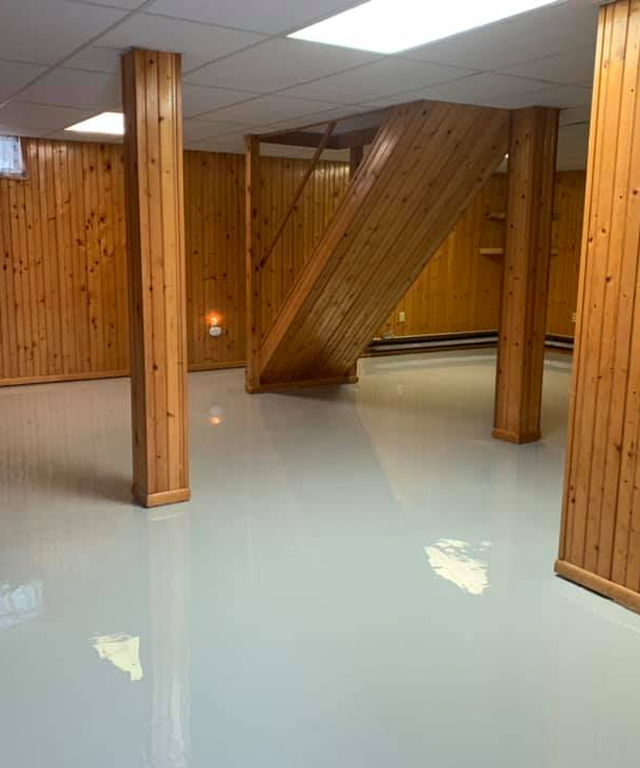
Yes, you can coat a concrete basement floor in South Carolina, and it can turn a cold, dusty slab into a clean, durable, easy-to-clean space. The one thing that makes or breaks the job is moisture. Basements and below-grade concrete deal with humidity and water vapor rising from the soil, so the floor has to be tested and prepped for that before any coating goes down. Handled correctly, a polyaspartic or epoxy coating resists moisture, stains, and mold and lasts for years. Here is what to know about coating a basement floor in our climate, why moisture is the deciding factor, and what a lasting job actually requires.
Are Basements Even Common in South Carolina?
Not especially, and that is worth being honest about. A lot of homes along the Grand Strand and across the Lowcountry sit on concrete slabs or crawlspaces rather than full basements, largely because of the high water table and sandy coastal soil. Basements are more common in the Upstate and in certain inland and hillside lots. So the real question for most South Carolina homeowners is broader: can you coat below-grade or ground-level concrete in a humid climate? The answer is the same either way. Whether it is a true basement, a partial below-grade room, or a ground-floor slab, coating the concrete comes down to managing moisture first.
The Moisture Challenge Below Grade
This is the heart of it. Concrete is porous, and below-grade concrete is in constant contact with the soil around and beneath it. Water vapor moves up through the slab, and in a humid climate there is plenty of it. If a coating is applied without accounting for that vapor, the pressure builds underneath and pushes the coating off the concrete, which shows up as bubbling, blistering, and peeling. Add general basement humidity to the mix and you have the exact conditions that cause a rushed coating to fail.
A basement floor coating does not fail because of the color you picked. It fails when moisture from below was never tested for or handled.
What Makes a Basement Floor Coating Last
A basement coating that holds up is really about the steps taken before the finish coat:
- Diamond grinding: the slab is mechanically profiled so the coating can bond into the concrete instead of sitting on a smooth, slick surface.
- Moisture testing: the slab is checked for vapor before anything is applied, which reveals whether extra protection is needed.
- Crack and defect repair: cracks and pits are filled so they do not become pathways for water or weak spots in the finish.
- A vapor-handling base when needed: if moisture readings are high, the right primer or base coat is used to manage vapor pressure from below.
- A real multi-layer system: a quality base and a durable top coat, installed by a trained crew, hold up far better than a single-coat DIY kit.
We coat concrete surfaces only, and every floor starts with this kind of prep. You can see the details of our basement floor coatings, which use the same careful preparation as our garage floor coatings.
Epoxy or Polyaspartic for a Basement?
Both can work on a basement floor, and each has strengths:
- Polyaspartic goes on thin and water-like, so it bonds down into the concrete pores. It is flexible, moisture-resistant, fast-curing, and UV-stable, which makes it a strong all-around choice for humid, below-grade spaces.
- Epoxy is thicker and builds a strong sealing layer. In some high-vapor situations a high-build epoxy base has its place, though epoxy is more sensitive to moisture during curing and can become brittle or yellow over time.
The right call depends on your slab and its moisture readings, which is exactly what a proper assessment sorts out before the work begins. For a deeper comparison, see our breakdown of polyaspartic vs. epoxy for the coast.
What a Coated Basement Floor Gets You
Beyond looking far better than bare concrete, a coated basement floor gives you real, practical benefits:
- Moisture and mold resistance: a sealed surface repels water instead of letting it soak into the concrete, unlike carpet that traps dampness.
- Easy cleaning: spills and dust wipe or mop right up.
- Durability: the surface stands up to foot traffic, storage, and daily use for years.
- A brighter, more usable space: a finished floor helps a basement work as storage, a workshop, a gym, or extra living space.
Thinking About Coating Your Basement or Concrete Floor?
If you have a basement or below-grade concrete floor in the Myrtle Beach area, Garage Kings Myrtle Beach can assess the slab, check for moisture, and install a coating built to handle our humid climate. Our floors start with real surface prep and are backed by warranties covering materials and labor. Call 843-892-6060 to get your quote, serving Myrtle Beach, SC and nearby areas.